


Once a hub of activity in Chicago’s Auburn Gresham neighborhood, the low-slung glass building now sits dark and empty. Garrett Morgan Elementary closed 13 years ago. The building’s first-floor windows are boarded up. Its doors are bolted shut.
Glass shards glitter on the playground, and a half-empty Gatorade is nestled in a layer of leaves that no one has raked. The sun has bleached the once-bright yellow seesaw. Even on a mild winter day, the swing set is still.

The school was one of 50 closed by the Chicago Public Schools in 2013, a part of the largest simultaneous school closure in American history. Drive or walk around the predominantly Black neighborhoods on the city’s South and West sides and you’ll see them — the most visible examples of the broken promises made by the city and school district.
Chicago and school districts elsewhere offer lessons for Cleveland about the tough realities that follow a decision to close so many schools that have anchored city neighborhoods for generations. And they demonstrate the fallout of failing to have a plan. At the same time, their experiences provide inspiration for how Cleveland can work with residents and others who want to bring the buildings back to life.

Cleveland’s school consolidation plan will shutter 18 buildings throughout the city, with more closures concentrated in East Side neighborhoods where many Black families live. These soon-to-be empty buildings could join 13 vacant buildings the district closed in the past and still owns, some of which have become eyesores for neighbors. (Other shuttered buildings have been demolished, redeveloped or now house charter schools.)
Cleveland’s city officials have said that these closures will be different. Mayor Justin Bibb has promised that the city will collaborate with the school district to “make sure that this land gets developed to help accelerate the change and transformation of this neighborhood.”
More than a decade ago, then-Chicago Mayor Rahm Emanuel made similar promises. But, today, fewer than half of the buildings are back in use. The rest, like Chicago’s Garrett Morgan, sit waiting.
Read more in this series
Old schools, new life: Lessons from Chicago and Kansas City
What’s possible? How Cleveland has reused former schools
‘Does money want to go here?’: Buying a school is easier than transforming it
In the past, when Chicago closed public schools, it frequently reused the buildings as charter schools. But in 2013, the district was struggling with city-wide enrollment declines, so its new goal was simple: sell the buildings off while preventing them from becoming charters. (A feasible proposition in a state that, unlike Ohio, doesn’t mandate charter schools get first dibs on these buildings if they go up for sale.)
Since then, more than half the buildings have sold, but that doesn’t mean they’ve found new life.
Looking back, part of that could be Chicago’s disjointed approach: sell buildings fast and outsource community engagement to aldermen (Chicago’s equivalent of city council members). By contrast, Kansas City, which closed nearly two dozen schools around the same time, focused on a broader strategy that relied heavily on transparent community engagement to re-energize buildings in distressed neighborhoods.
A few years after the closures, in response to criticism the district wasn’t dealing with the buildings quickly enough, Chicago abandoned the requirement that aldermen conduct public meetings. It then put many of the remaining schools up for sale via a competitive bidding process. So, in later years, community input was minimal and resulted in a number of sales that would later fall through.

The district also rejected recommendations made by an advisory committee to reinvest money from schools that sold quickly into a fund that would have been dedicated for buildings in neighborhoods where finding the lenders and investors for a building was more challenging.
That could have helped Ghian Foreman. Foreman is a partner at the Washington Park Development Group, which purchased Anthony Overton Elementary three years after it was closed in 2013.
The school in the Bronzeville neighborhood on Chicago’s South Side has weathered over a dozen winters since it closed. It has the cracked windows and faded brick to prove it. Despite the wear and tear, the building, designed by a local architecture firm in a modernist style, is beautiful.

It was named after Anthony Overton, a formerly enslaved Black man who became a pioneering banker and businessman manufacturing cosmetics and selling life insurance. At the time the district closed the school, its student body was 92% Black and most of its students were from families that had lower incomes.
It was also the heart of the neighborhood. Dozens of people attended the meeting about whether to close the school. One student testified that she hadn’t been learning at her old school and Overton had changed her life. Another said he’d struggled with academics his whole life but at Overton found teachers who took the extra time to help him. Parents said they felt safe sending their kid to the school – it was like family.
Foreman grew up not too far from Overton, and his aunt was a teacher there. Redeveloping the school was his way of adding to the community with workspaces for startup businesses and small nonprofits.
He bought Overton for $325,000. Compared to what followed, the sale was relatively easy – he spoke to the area’s alderman and got approval.
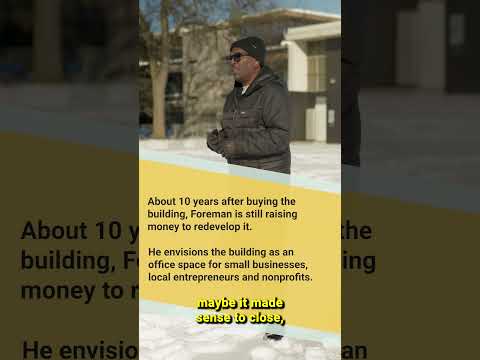
Since then he’s struggled to make progress. The typical way a developer might fund this kind of project — with a combination of cash from investors and loans — is out of the question because a bank won’t recognize the small businesses and nonprofits as reliable tenants for a construction loan.
“We’ve been piecemealing [the financing] the whole time,” he said. “Ten years, we’ve been piecemealing, and we still don’t kind of have everything right.”
It’s not as though Foreman hasn’t tried. He managed to put the building on the National Register of Historic Places so it would qualify for tax credits. And after years of going back and forth with the city, he applied for and received tax increment financing, which can help with local infrastructure and redevelopment projects. He has also worked to attract investors and philanthropic funding.
Part of why it’s so hard is that Bronzeville, like many neighborhoods on the city’s South Side, has struggled with population decline that began after the city demolished a large swath of high rise public housing in the mid 2000s, displacing thousands of people. As a result, the neighborhood already has its share of abandoned homes and vacant lots.
Foreman believes that another part of the problem is that there’s a disconnect between what investors and lenders see in these schools and what communities see.
“You wouldn’t have so many vacant lots, because money would go into the vacant lots,” he said.
The story of what happened to these buildings looks very different on Chicago’s wealthier North Side. There the schools that closed in 2013 represented attractive investments. They were sold easily and early and redeveloped as luxury apartments with $2,000 or $3,000 monthly rents.
In Foreman’s view, the city and the district needed to account for these differences from the jump. He thinks that before trying to sell the buildings, the district should have asked: “Does money want to go in here?” Had the district found ways to address that question, things might look different.
There are also ways the city could have supported him after the sale, he said. For years, his development group has tried to keep the building active by letting local after-school programs use the gym and outdoor space. In Foreman’s view, had the Chicago Parks District stepped up and offered to rent the space for this same kind of programming, it would have kept the building active and given him a reliable tenant to list on a construction loan application.
“The city doesn’t know what they’re doing. They’re trying to get this off of their books,” Foreman said. “I think it has to be thought about more holistically. You want to get it off your books? Great, get it off your books, but then there should still be some liability.”
Signal Cleveland reached out to Chicago Public Schools multiple times to discuss the 2013 closures as well as with specific questions about the criticisms levied by Foreman and others but did not receive a response before publication.
‘A reminder that nobody cared’: The cost of these buildings
It’s hard to pin down what vacant buildings cost their surrounding neighborhoods and the city overall.
A WBEZ analysis of census data found that neighborhoods whose schools closed saw steeper population declines than those where schools remained open – though it’s tricky to isolate whether school closures were responsible.
The population dips were especially pronounced in majority Black areas where schools closed. Those census tracts lost 9.2% of their residents between 2013 and 2018 as compared to a 3.2% dip in areas where schools didn’t close.

Then there’s how it feels to have a dilapidated building as your neighbor.
That was the case with the former Robert Emmet Elementary in Chicago’s Austin neighborhood. It sits smack dab on the corner of two busy streets at the center of the community.
“It was just sort of this visual, boarded up representation of the lack of investment, a reminder that nobody cared,” said Max Komnenich, the architect who would later help transform Emmet.
There were also costs exacted by allowing the buildings to physically deteriorate. Komnenich remembers the first time he walked into Emmet he thought he’d stepped into a horror film.
Everything was flaking, peeling and crumbling. The air felt like an ice chest. Nothing from the electricity to the plumbing to the HVAC was still functional.
“I think what just happened is they just left and locked the doors,” Komnenich said. This carelessness made construction more costly and time-consuming in a lot of cases.
Even if they’re empty, the district remains on the hook for maintaining the buildings they own. Stephen Stults, who manages real estate for Chicago schools, estimated during a recent board meeting that the district spends between $75,000 and $150,000 in public money on each empty building each year.
After sitting for five years, Emmet Elementary was sold to a local health-focused nonprofit. At the time, the group didn’t have a fully fleshed out plan about what they wanted to use it for or how they would pay for what, in the end, amounted to a nearly $40 million renovation.
“It was just sort of this visual, boarded up representation of the lack of investment, a reminder that nobody cared.”
Max Komnenich, the architect who helped transform Emmet.
The health nonprofit decided to partner with another neighborhood group. Eventually, it was community organizing that got the ball rolling.
“They fundraised the first $20,000 from the community, just five bucks here, 10 bucks there,” Komnenich said. After that, they got lucky. The project was named as a finalist for a redevelopment funding competition, which opened the door for money from both the city and the state.
Today, Emmet Elementary is known as the Aspire Center. It offers job training for community members, a bank branch and co-working spaces. It’s an example of what’s possible with these buildings. But it’s also a reminder that their transformation takes both money and time.
Those costs are something Foreman encouraged Clevelanders to think about. In the Austin neighborhood, they made sense, in part because of the school’s central location and role in improving quality of life for the community. But that’s not true of every school, and when it comes to high school buildings, which are bigger, the projects can total hundreds of millions of dollars.
“Well, is this worth it?” Foreman said. “Is that the best way to invest $100 million into this neighborhood? I don’t know.”
Beyond remodel: Other ways these buildings can serve communities
Costly remodels aren’t the only ways to keep these buildings active. In Chicago, a number of buildings have been reused with relatively few renovations — keeping costs down and allowing new stewards to focus on providing services to the community.
That’s what Pastor Michael Neal has done with Florence B. Price Elementary School, which is a couple dozen blocks from Overton in the Bronzeville neighborhood. When Neal’s congregation leased the gym of the school to host weekly worship services in 2011, they didn’t know it would soon be closed.
“We saw the air being sucked out of the building, even though we were just having worship on Sundays,” he recalled. Rather than start searching for a new space, Neal went to the school district to find out if the church could continue leasing the space for worship.
In the back of his head, he also had a more ambitious goal in mind: Reopen the school as a community center.

Today, what’s now the Timothy Center bustles with life. It’s a humbler version of the Aspire Center. One that has space to host children’s birthday parties, grief support groups and spin bike classes all at once. And where the heating has to be jerry-rigged to keep the temperature bearable.
Early on the Saturday just before Christmas, the gym was filled with volunteers arranging lego sets and nerf guns on tables decked in red and green for a toy giveaway later in the day. A group of women with yoga mats slung over their shoulders filtered into a classroom that still has chalkboards affixed to the walls for an early morning yoga class. Across the hall is another classroom that Neal said will host weekly financial literacy and leadership classes starting in the new year.
Neal, who lives not far from the school, has also tried to honor what it meant to people. One room is dedicated to Florence Price, the school’s namesake and a trailblazing Black classical composer. The room is painted pink, and notes from one of her songs are inscribed on the wall. A piano left behind in the school waits to be played.
“I want to make sure that I keep this legacy alive,” Neal said. “This room, we hold it, somewhat, sacred.”

The repurposed elementary schools are still serving their communities, but they could just as easily have ended up like the old Von Humboldt Elementary. That school was sold to a developer who had plans to turn the building into a “teachers’ village.” Despite considerable public investment, the project has been stalled for years.
In Kansas City, a different reuse process
Foreman wishes Chicago had committed to a process where the goal wasn’t to sell the buildings but to address this question: “How is this going to impact the community overall?” Instead, they tried to, as he puts it, “solve an atypical problem with typical solutions.” (Cleveland’s city leaders have said that their process will prioritize reuse over sale.)
That’s how Kansas City Public Schools approached the 22 schools the district closed from 2009 to 2010, Lange said. Their process prioritized two things: community input and making sure that proposed projects panned out. It was a new approach for a district that had previously sold buildings for the highest price, which often resulted in them sitting empty for decades.
“We were committed to and the board has been committed to never seeing that happen again,” Jesse Lange, who leads the Kansas City school office dedicated to building reuse, told Signal Cleveland.
Having a dedicated office means residents know exactly where to turn when seeking updates on the empty buildings. Lange also regularly sends email blasts to neighborhood associations throughout the city updating them on the status of various properties in their areas — and helps figure out how to address vandalism and break-ins at empty properties. The district also has a comprehensive website that tracks the status of every closed building. It also lists each proposal for reuse, community surveys and feedback on the site.
When a school building is closed, the district begins the process with a community tour meant to honor what the school meant to people. Then it conducts listening sessions with neighbors about what they want to see these buildings become. That information gets posted publicly, and the district asks that would-be buyers incorporate neighborhood feedback into any proposals they submit.
(City planners in Cleveland have said the feedback they are gathering in recent listening sessions will be incorporated into any calls for proposals, but ultimately it’s up to the school board to vote on what happens to a property.)
After the school district receives proposals for a building, it vets them for financial viability before asking neighborhoods to vet them for compatibility as well. A couple of years ago, the district also started requiring community benefits agreements – legally binding contracts where a developer agrees to provide the community with certain amenities — for any building sale. For example, one project that turned a school into senior housing also created a fund for neighbors to use for home repairs.

The district has also worked hard to address some of the financing challenges would-be buyers face in making their projects work, Lange said. It put the buildings on the market in phases rather than all at once. And in neighborhoods hit by blight, the district is open to offering tax incentives or working out creative financing on a case-by-case basis.
‘They worked with me’
Karen Allen is one of those buyers. Allen grew up in Kansas City and her cousins attended Dunbar Elementary many years ago, when the neighborhood was a vibrant, predominantly Black community. The school, named after the famous Black poet, was closed in 2011, after the population of the neighborhood began to dwindle.
But Allen didn’t know it closed until years later, when, on the way home from church in the neighborhood, she took a detour down memory lane to visit her cousins’ old home. On the way, she passed the school and discovered a for sale sign.
Allen, who has spent the last 20 years providing daycare services to adults with developmental disabilities, autism and Alzheimer’s disease, called to ask about moving her facility into the school. At first, she was told she’d have to bid on the property, which seemed financially out of reach given that Allen mostly cares for people who receive Medicaid. She forgot about the property until the district called her.
“The school district came to me and said, ‘We want to talk to you.” And I go, ‘I don’t have any money. I don’t have no credit. So what do you want?’” she recalled. “They said, ‘No, no, wait a minute, this is what we want to do,’ and they offered me a five-year lease.”
In the end, Allen paid $2,400 a month for five years, plus an upfront deposit and some money at the end of the lease. Now, she owns Dunbar. It was still a lot of money, but undoubtedly the flexibility from the district made buying the school financially viable for her. The district also responded when there were bumps. For example, when the building experienced break-ins, it helped install security cameras on the property.
“They worked with me,” she said. “They worked with me to the very last minute.”
At a school a dozen blocks from Dunbar, the district also worked out a lease-to-sale arrangement with a local nonprofit that offers tutoring in math and reading. Like Allen, the W.E.B. DuBois Learning Center couldn’t afford the building outright, so the district was willing to count both rent payments along with volunteer tutoring hours in Kansas schools toward the purchase price.
Since Kansas City officials started their current process more than decade ago, they’ve handled more than 30 vacant buildings — the district continued to close schools after 2010. As of today, four have been reused by the school district, 15 have been fully redeveloped and the rest are in progress. Only five are vacant and held by the district, and one of those is currently under contract.
“They worked with me. They worked with me to the very last minute.”
Karen Allen, owner of Dunbar Elementary School
This relative success doesn’t mean the process is friction-less or quick. Angie Lile lives near two school buildings that were closed before 2010 and are still vacant.
The district rejected a proposal to redevelop Bingham Middle School after neighbors, including Lile, didn’t want a big box store on the property. Most neighbors wanted the property to be repurposed as a library, and the district agreed not to solicit new proposals until the Kansas City public library system has finished ongoing facilities planning.
Progress on Robeson, another middle school, is currently stalled because partners who committed to repurposing it as a community center dropped out of the process. Lile said, based on that experience, she wishes the district had stronger clawbacks — legal or financial methods to wrest back ownership of property in the cases where a buyer doesn’t deliver.
Overall, she said that she and other neighbors like working with the district, which has been pretty responsive when illegal activities happen on the old school sites. It also does a good job of notifying neighbors about where to give input.
“We’re one of the few districts, where the district is accountable to the community with what they do with their buildings,” she said.