


In almost every way, Connor Adams of Shaker Heights is a typical sophomore at Ohio State University.
He attends Buckeye football games, hangs out with fraternity brothers and hustles to get to classes on time on the large Columbus campus.
But among the nearly 47,000 undergraduates, Adams is as singular as the student who dots the “i” on the Ohio script during the Ohio State marching band’s halftime show. But he has far more at stake.
The 19-year-old is literally a walking study who could hold the key to treating a medical disease that could help change the lives of thousands.
“Basically, my doctor describes me as special,” Connor said.
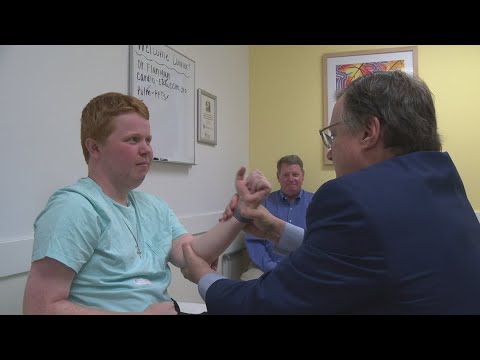
He was diagnosed 10 years ago with Duchenne, the most common and serious form of Muscular Dystrophy. It forces most people with the disease into a wheelchair at an early age.
Adams, however, produces a little more dystrophin – a special protein that stabilizes muscles – than most with Muscular Dystrophy. Adams makes roughly 3% of normal levels, and that tiny amount allows him to walk.
“Now, I don’t think there’s really the only explanation that I have produced dystrophin is why I’m not in a wheelchair,” Adams said. “But other than that, it’s not really an explanation why I’m not.”
For this reason, he’s critical to research at Nationwide Children’s Hospital in Columbus, which is studying Adams’ progress and that of others like him. That research — and work on alternative therapies for those with Muscular Dystrophy – has been backed for years by federal money from the National Institutes of Health.
President Trump’s administration now limits what researchers at hospitals and universities can spend on overhead costs related to research. Some worry this will force research labs to scale back or close, delay clinical trials for Duchenne or other diseases, or cause young researchers to leave the field due to its instability. For this reason, Adams is speaking up, to help people see the direct line between federal money and the lives it is changing.
Adams and Dr. Kevin Flanigan form important bond
Growing up, Adams’ family noticed he had a hard time climbing steps, initially chalking it up to tight calf muscles. Nonetheless, Adams played alongside his brother and sister and neighborhood friends.
“I was always, like, slower, and I didn’t have as much strength as other kids, but I played all the sports like everyone else,” Adams said. “And I would say I was pretty good at baseball when I was younger.”
After Adams began having more trouble picking himself up from the floor, his family pursued medical evaluation. Diagnosed with Duchenne, he was connected to Dr. Kevin Flanigan, the director of the Jerry Mendell Center of Gene Therapy at Nationwide Children’s Hospital. Flanigan has been treating and studying Adams for nearly a decade.
“When I met Connor … it was quite clear he looked different from typical Duchenne,” Flanigan explained. “He had a mutation that, on paper, would make no dystrophin whatsoever, yet he looked really different.”
And for researchers studying the disease, Adams’ stability as a young adult makes him critical to understanding how small amounts of dystrophin can protect muscle function — and how new therapies might replicate that effect.
“Three percent (of normal levels of dystrophin) is sufficient for keeping you walking around the OSU campus,” Flanigan said.
Adams’ participation in research (and his access to the medication he takes) depends heavily on NIH grants.
“The NIH has historically been good funders of muscle disease research,” Flanigan said. “One of our grants has been to survey many patients who are the exceptions to the rule.”
For Adams, the uncertainty around NIH funding is deeply personal because patients like him could lose access to experimental or specialty treatments.
“That’s what my doctor is nervous about,” Adams said. “Maybe it gets shut down; he can’t study my cells anymore.”
Decades of progress at risk
NIH funding has fueled breakthroughs that were once unimaginable and is helping turn Duchenne from a fatal childhood disease into a condition that may one day be treated or slowed significantly.
Flanigan noted that before any current treatments existed, walking past age 12 was rare — and living past age 20 was often considered unlikely.
Researchers fear that pulling back support now could undo years of progress.
“When I first started, I couldn’t look a parent in the eye and say that anything in trials would meaningfully impact their child’s life,” Flanigan said. “I can easily say that now.”
Helping kids with childhood cancer
Even before he was diagnosed with Duchenne, Adams was drawn to helping people with disease, shaving his head every year as a grade schooler for the St. Baldrick’s Foundation, which raises money for childhood cancer research.

“I’ve shaved my head for 12 years straight, and the reason I wanted to do this is because I felt like I could help,” Adams said. “If I could help other kids, like anyone else, I would do it.”
Though he’s living with Duchenne, Adams is still focused on helping others.
At Ohio State, he founded the university’s first St. Baldrick’s chapter, rallying classmates, athletes and fraternity brothers to join the cause.
Studying sports management at Ohio State, he hopes to run a Major League Baseball team some day. But he also acknowledges he’s carrying a weight not everyone sees — and federally funded research is what keeps him moving forward.
“I know, in the back of my mind, things could change at any point,” he said. “Right now, I just feel like living whatever life I want to right now.”